Frying Oils: Stability Is a System Property
Frying life cannot be read from one profile number or one lab test.
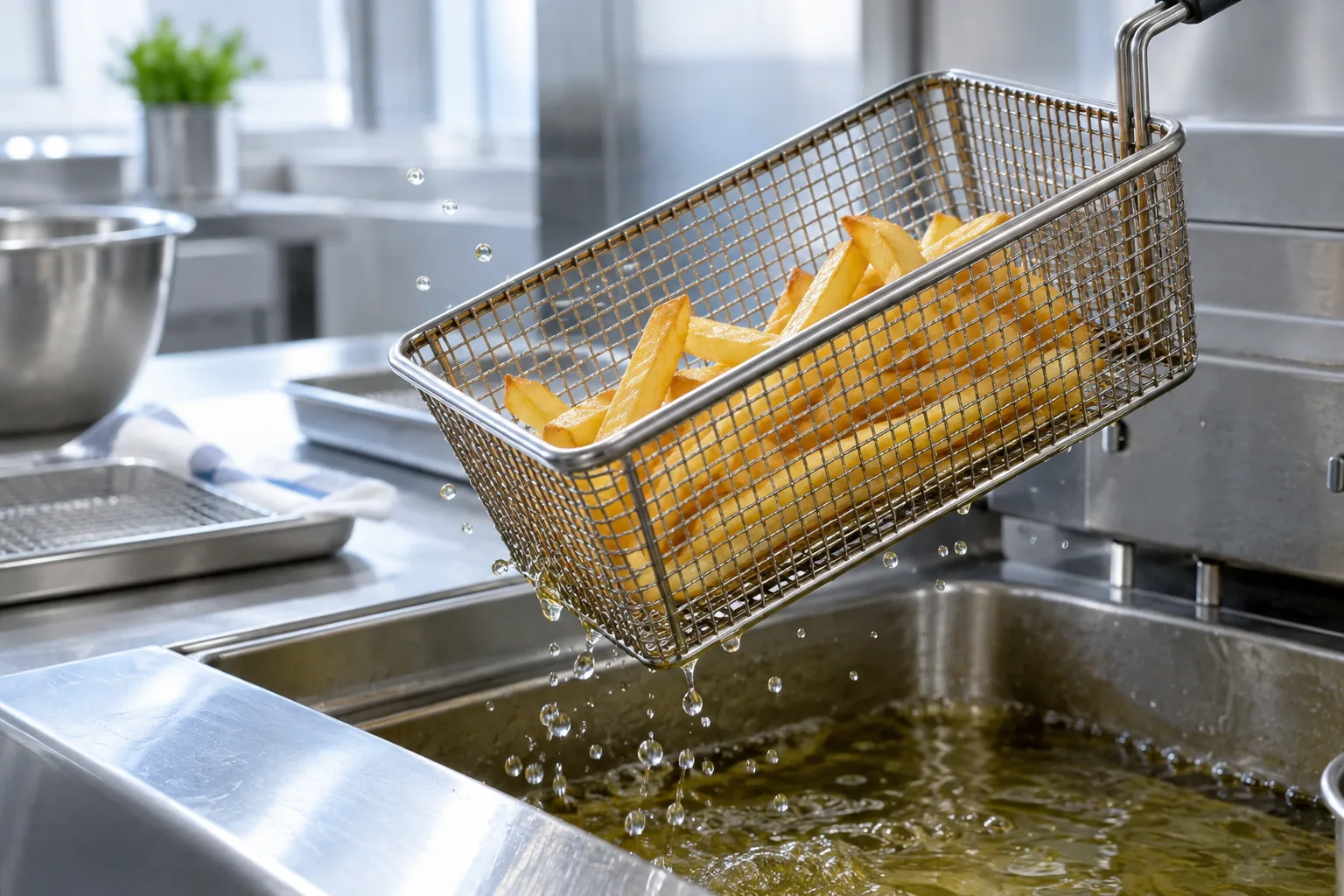
Frying oil wears out. Heat, water from the food, air and food particles gradually break it down until it has to be topped up or replaced. How quickly that happens affects both food quality and cost.
Oil choice matters, but it is only part of the picture. This article explains what drives oil breakdown, how to monitor it and how to judge an oil by its cost in use.
The fryer is a system.
Oil, food, heat, air and routine all change the oil together.
During frying, water from the food splits fats into free fatty acids, while heat and air oxidise them. Food particles and long idle periods at high temperature speed this up, while regular filtering and fresh top-up oil slow it down. That is why the same oil can last much longer in one fryer than in another.
- Water from food drives hydrolysis; heat and air drive oxidation.1
- The same oil can last differently in different fryers.
Profile shapes stability. It does not set a timer.
More double bonds generally mean faster oxidation.
Fatty acids with more double bonds oxidise faster, so an oil's profile gives a first indication of its stability. It does not tell the whole story. 'Vegetable oil' can mean very different profiles, and refining, natural antioxidants and the oil's starting quality all affect how long it lasts.
- “Vegetable oil” hides big differences in profile and minor components.2
- Initial quality and antioxidants matter too.
“The oil failed early” may be the fryer, not the oil.
Monitor what you can measure.
Each test sees a different kind of change.
Checking colour and smell is useful but not enough on its own. Total polar compounds measure overall breakdown, acid value tracks the free fatty acids formed by water, and polymer tests show heavier breakdown products. Many countries set limits for when oil must be discarded, and those limits differ, so follow the local rule and keep results in a fryer log.
- Discard limits differ by country. Use the local rule.3
- Pair tests with fryer logs and staff training.
Compare cost in use.
Purchase price is only part of the cost.
The cheapest oil to buy is not always the cheapest to use. A more stable oil may need fewer changes, less topping up and less downtime, and it can protect food colour and flavour for longer. Compare oils on consumption, change frequency, food quality and labour over a real operating period.
- A more stable oil can cost more to buy and less to use.1
In short.
Frying-oil life comes from the oil and the operation working together. Choose an oil that suits the food and the fryer, run the fryer with good temperature, filtering and top-up habits, monitor with the tests your market requires and judge the result by total cost in use.
Before you choose.
- 1Define food, throughput and temperature.
- 2Review the oil specification.
- 3Control the process.
- 4Set a monitoring plan.
- 5Follow local rules.
Composition influences stability. Fryer, food, moisture, heat and turnover also drive degradation.
Frying is studied as a coupled food-oil process. Monitoring matters as much as oil choice.
Match the oil to the food and the fryer.
Talk to our teamReferences (3)
- Valle, P. R. et al. (2024). Deep-frying impact on food and oil chemical composition: Strategies to reduce oil absorption in the final product. Food Safety and Health, 2(4), 414–428. doi.org/10.1002/fsh3.12056
- Abrante-Pascual, S., Nieva-Echevarría, B. & Goicoechea-Oses, E. (2024). Vegetable oils and their use for frying: A review of their compositional differences and degradation. Foods, 13(24), 4186. doi.org/10.3390/foods13244186
- Food Safety and Standards Authority of India (2021). Manual of methods of analysis of foods: Oils and fats. mail.fssai.gov.in/upload/uploadfiles/files/Manual_Revised_Oil_Fats_22_06_2021.pdf
General principles for formulators. Not recommendations for a particular product, process or herd.