
Industrial Fatty Acids: Match Feedstock to Function
The best oil in general is rarely the right one for a specific product.
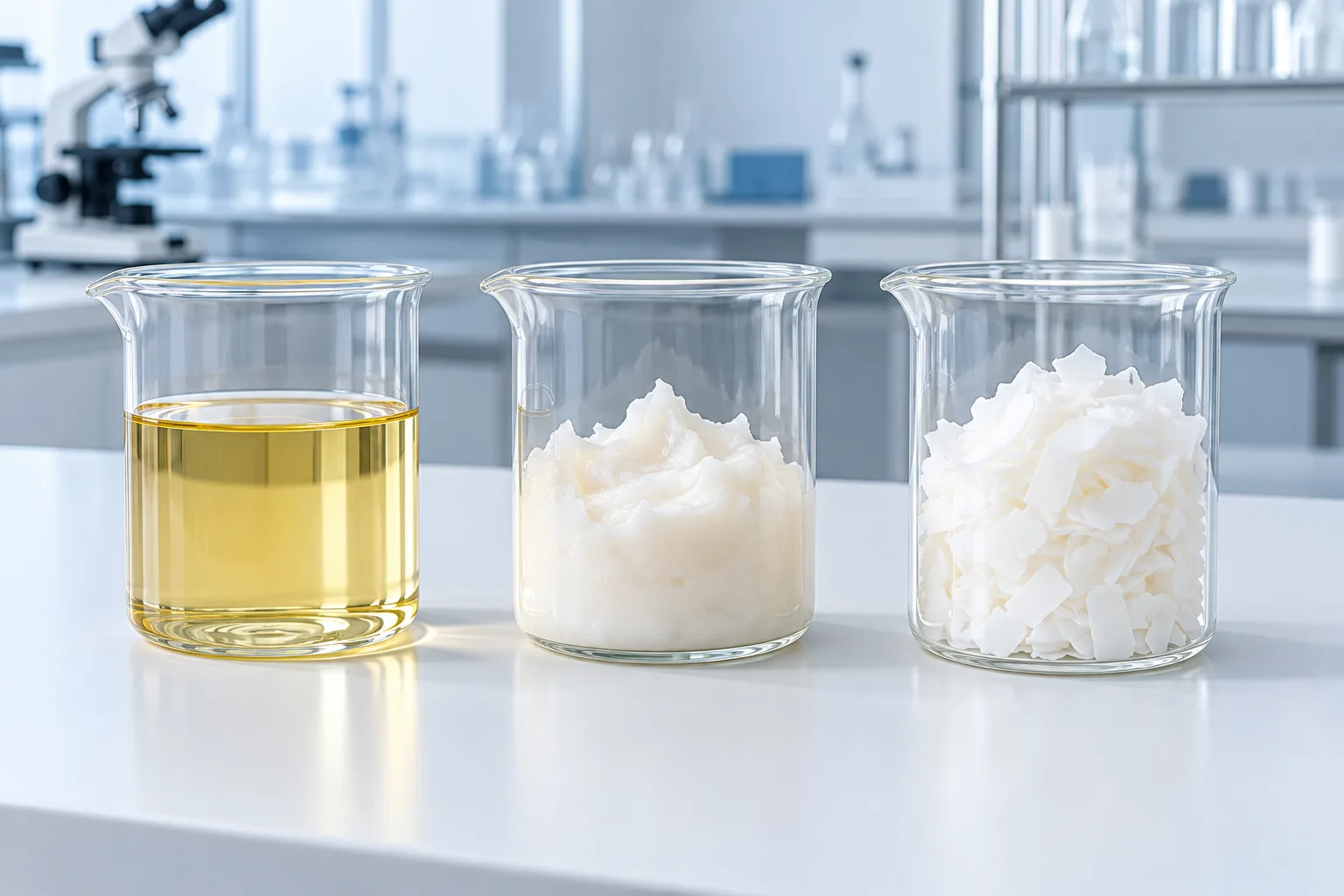
Fatty acids from vegetable oils and animal fats are the starting point for soaps, surfactants, lubricants, coatings and many other products. For an industrial buyer, the question is which fatty acid, in which form, will give the final product the properties it needs.
This article covers the three things that shape that choice: chain length, unsaturation and chemical form.
Start from the property.
Work backwards from what the final product must do.
The most reliable way to choose a feedstock is to start at the end. Define the property the final product needs, such as melting range, viscosity or solubility. Then work back through the derivative and the reaction that will make it, and only then choose the fatty-acid profile that fits.
- Oils and fats are an established renewable platform for chemicals.1
Chain length changes behaviour.
Longer saturated chains melt higher. A double bond drops the melting point sharply.
Chain length has a strong effect on melting point. Saturated chains melt higher as they get longer: lauric acid (C12:0) melts at about 44 °C, palmitic (C16:0) at about 63 °C and stearic (C18:0) at about 69 °C. A single double bond changes this sharply, and oleic acid (C18:1) is liquid at room temperature. Real feedstocks are mixtures, so the blend decides the final behaviour.
- Commercial feedstocks are mixtures, not single molecules.
- A liquid intermediate may need an unsaturated or esterified form.
Bio-based describes origin, not a full lifecycle assessment.
Double bonds: reaction sites and risk.
A double bond can be hydrogenated, epoxidised or cleaved. It also invites oxidation.
A double bond is a useful reaction site. It can be hydrogenated, epoxidised or split to make new building blocks for polymers, coatings and specialty chemicals. It is also where oxidation starts, which can change colour, odour and viscosity in storage. Where the chemistry depends on double bonds, they need protecting through transport and storage.
- Where chemistry depends on it, protect the profile through storage and handling.1
Compare at the derivative level.
Plants buy acids, esters, alcohols or amines. Each handles differently.
Plants rarely buy a fatty acid in the abstract. They buy a free fatty acid, a methyl ester, a fatty alcohol or a triglyceride, and each has its own handling and reactivity. Compare candidates in the form that enters your process. Claims about renewable origin need separate evidence, because origin alone does not show lifecycle impact.
In short.
Choose industrial fatty acids by working backwards from the final property, through the derivative and the process, to the feedstock. Chain length and double bonds set the options; chemical form, purity and stability decide whether a material will run well in your plant.
Before you choose.
- 1Start from the application spec.
- 2Specify the chemical form.
- 3Review the full profile.
- 4Check the conversion route.
- 5Evidence sustainability claims.
Chain length, unsaturation and chemical form drive conversion and end use.
New routes use double bonds and other groups, and explore microbial oils. Viability depends on supply, yield and lifecycle.
Work backwards from the final property.
Talk to our teamReferences (3)
- Biermann, U., Bornscheuer, U. T., Feussner, I., Meier, M. A. R. & Metzger, J. O. (2021). Fatty acids and their derivatives as renewable platform molecules for the chemical industry. Angewandte Chemie International Edition, 60(37), 20144–20165. doi.org/10.1002/anie.202100778
- Rahmawati, Z. et al. (2024). Biomass as an alternative feedstock to oleochemicals. RSC Advances, 14, 28827–28843. doi.org/10.1039/D4RA04481A
- Hayes, D. G. (2017). Fatty acids-based surfactants and their uses. In Fatty Acids: Chemistry, Synthesis, and Applications (AOCS Press), 355–384. doi.org/10.1016/B978-0-12-809521-8.00013-1
General principles for formulators. Not recommendations for a particular product, process or herd.